BY : Obianuju Mbah Christian Today
Christians in eastern Democratic Republic of Congo (DRC) are facing escalating violence from an Islamic State-linked militant group accused of massacres, abductions and systematic terror attacks across villages and churches, according to a major new Amnesty International report.
The 61-page report titled, ‘I’d Never Seen So Many Bodies’: War Crimes by the Allied Democratic Forces in the eastern Democratic Republic of Congo, documents atrocities carried out by the rebel ADF movement operating in North Kivu and Ituri provinces, where many communities are overwhelmingly Christian.
Amnesty concluded that many of the abuses amount to war crimes and crimes against humanity.
The human rights organisation said its researchers conducted investigations in eastern Congo between October 2025 and February 2026, interviewing 71 people including survivors, witnesses, humanitarian workers, civil society representatives, military and police officials, and UN-linked personnel.
The report noted that “the vast majority of the ADF’s victims have been Christians,” largely because the group’s operations are concentrated in predominantly Christian areas.
Amnesty also highlighted the religious rhetoric increasingly used by the militants.
According to the report, a propaganda video released by the Islamic State’s Central Africa Province (ISCAP) in September 2025 described the group’s mission as backing Islam against “crusaders.”
One of the deadliest incidents documented was an attack on a church in Komanda village, which took the lives of over 40 worshippers during a massacre that drew international condemnation.
The report described repeated assaults on villages, funeral gatherings, farms and health facilities, with attackers often using machetes, axes, hammers and guns.
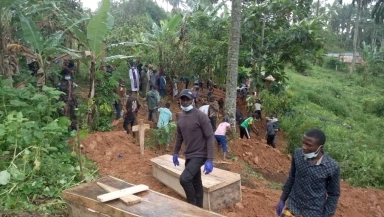
In one of the most horrific incidents, fighters disguised themselves as civilians and infiltrated a funeral wake in the village of Ntoyo on September 8, 2025, before launching a mass killing, in which over 60 people died.
A survivor discovered the bodies of her parents the next morning and said: “I’d never seen so many bodies.”
Many survivors said they felt abandoned by security forces, who either arrived too late or failed to intervene altogether.
A woman injured during an attack in Otmaber on July 12, 2025, said militants shot her, her husband and their seven-year-old son before burning homes.
“Even in the morning, [the military] didn’t come,” she said. “Everyone had to take care of themselves.”
Another survivor who escaped an assault on a health centre in Byambwe in November 2025 described scenes of panic and indiscriminate violence.
“You couldn’t stand; they shot at anything that moved,” the elderly survivor said after crawling out of the building to safety.
The report also detailed the long-term trauma experienced by survivors.
One woman whose child died after their home was burned down and had survived a head injury during a machete attack in August 2025 said: “I have been consumed by fear.”
Another asked: “What have we done to deserve these things that are happening to us? How much more must we suffer before this ends?”
Amnesty said the ADF’s campaign extends far beyond killings.
Investigators documented dozens of abductions, including children taken into militant camps deep in the forest where they were subjected to forced labour, beatings and ideological indoctrination.
Former abductees said children were trained to fight and pressured to adopt Islamic practices under threat of death.
One young man abducted as a child said militants “preached Islam to us” and forced captives to participate in prayers.
“If you refused, they could kill you,” he said.
A girl abducted before the age of 15 said captives were taught Arabic and later trained for attacks.
Women and girls reportedly endured some of the worst abuses.
Amnesty interviewed survivors who described being coerced into “marriages” with fighters, subjected to repeated sexual and physical violence, and threatened with death if they refused.
The report also said some fighters were given multiple “wives”, with girls as young as 12 were reportedly forced into marriage, and many women and girls becoming pregnant during captivity as a result of sexual slavery and coercion.
One teenager recalled a commander telling her: “Either you accept a husband or we kill you.”
The report further warned that survivors often return to communities facing stigma, poverty and little psychological or medical support.
Some women said relatives pressured them to abandon or even kill children born during captivity.
Amnesty International Secretary General, Agnès Callamard, said civilians in eastern Congo were enduring “a dehumanising campaign of abuse.”
“The ADF’s violence is contributing to an escalating humanitarian crisis,” she said. “The group’s attacks have increased displacement and disrupted basic services, including access to food, healthcare and education.”
The organisation urged the Congolese government, Ugandan authorities, the United Nations, the African Union and the wider international community to strengthen civilian protection measures, improve early warning systems, support justice and accountability efforts, and provide long-term medical, psychological and reintegration support for survivors and affected communities.
Amnesty also called on the ADF to immediately cease attacks on civilians, end abductions and sexual violence, stop recruiting and using children, and release all captives still being held by the group.
Ms Callamard remarked: “The group’s relentless attacks underscore the extent of insecurity and overlapping crises in the eastern DRC and highlight the urgent need for the government and the international community to intensify efforts to protect civilians and bring those responsible to justice.
“Survivors told us that peace and security must be urgently restored in the eastern DRC if they are to rebuild their lives.
“The disregard in international policy and donor circles to ADF’s expansive threat and crimes will only continue to undermine security and human rights in the eastern DRC.”
The ADF emerged in Uganda during the 1990s before establishing itself in eastern Congo.
The Islamic State formally recognised the group’s allegiance in 2019, after which it became associated with ISCAP.
Amnesty argues that international attention on a separate conflict involving the Rwanda-backed M23 rebel group may have allowed the ADF to intensify attacks while security resources were diverted elsewhere.
Photo Courtesy :