Compassion International tells African churches to prepare before the El Niño floods, not during

BY : Christian Daily International
Compassion International is urging African churches to prepare adequately for what weather experts say will be one of the strongest El Niño events expected to take place from October 2026.
Faith Magadi, the organization’s Senior Manager for Disaster Response, told Christian Daily International that churches need to build relationships with the police, local administrators and emergency agencies before the onset of El Niño and not in the middle of one.
Magadi, who has spent a decade in disaster response, urged churches that “preparation cannot wait for the rains.”
With forecasters projecting one of the strongest El Niño events on record, Magadi’s advice to the 8,000 local churches that the NGO partners with in 29 Africa countries is that there is a high chance most countries in East Africa will experience severe flooding events due to the El Niño phenomenon.
She said recent predictions from the National Oceanic and Atmospheric Administration (NOAA), the United States agency whose climate outlooks are used worldwide, indicate this could be one of the strongest El Niños in recent times.
“The way El Niños behave is; sometimes it is predicted to be really strong and it does not come out as strong. Sometimes it’s not predicted to be really strong and it comes out stronger than predicted,” she said. “With El Niño, there’s always a 50/50 chance, but this one is looking more and more likely as time goes by.”
NOAA’s Climate Prediction Center said in June that El Niño had formed and placed the probability of a “very strong” event, meaning sea surface temperatures more than 2.0°C above average in the monitored Pacific region, at 63 percent. By mid July, the International Research Institute for Climate and Society recorded the weekly Niño 3.4 index at 2.1°C above average, with almost all models in its ensemble pointing to a very strong peak between October and December.
Compassion’s guidance to its national offices has been to work with local rather than global forecasts.
“Listen to your local meteorological department, because they’re likely to have their pulse on what’s happening locally,” said Magadi.
Drawing on past events, she named Kenya, Uganda, Ethiopia, Tanzania and Rwanda as the East African countries Compassion considers directly exposed, with flooding from excess rain as the primary threat. Somalia is historically affected but falls outside Compassion’s operations.
She also flagged West Africa, which she said is exposed in a way it has not been in previous El Niños, naming Ghana, Togo and Burkina Faso.
“If you have been following a bit of international news, you will see that Ghana in July alone and late June has received rainfall that has exceeded expectations,” she said, citing closures of institutions, roads and bridges. “We have already started to see the impact in Ghana.”
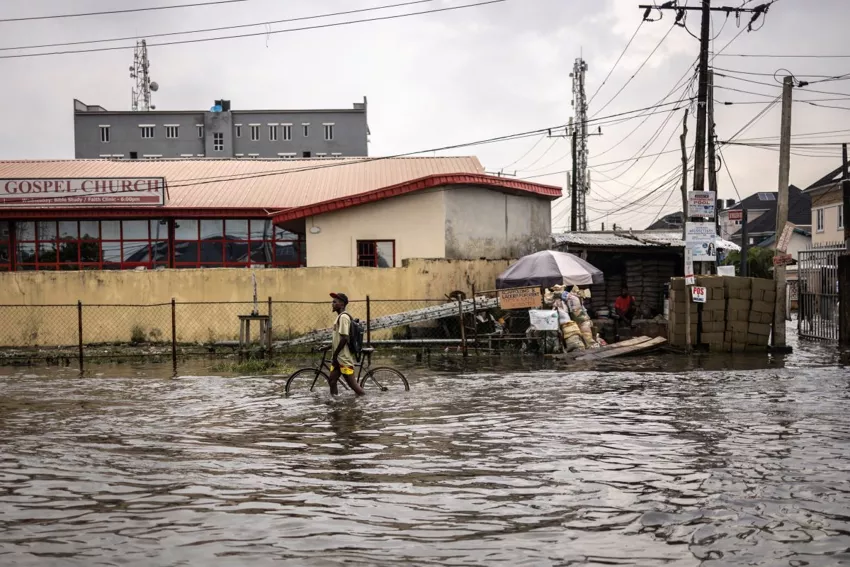
Accra was struck by severe flooding on June 29, with dozens killed in Ghana and neighbouring Côte d’Ivoire. Ghana’s interior minister, Mohammed Muntaka Mubarak, told parliament that 12 people had died, seven were missing, 7,761 households were displaced and 38,802 people affected across more than 25 communities.
President John Mahama said preliminary data showed about 140 millimetres of rain fell on the capital. Analysts have attributed the recurrence of flooding in the same neighbourhoods, hit also in 2023, 2016 and 2015, largely to spatial planning, drainage and watershed management rather than rainfall alone.
Asked whether a strong El Niño would produce a temporary setback or a longer crisis, Magadi described a chain reaction.
“A flood is compounding on top of poverty. Compounding on top of a failed rain season. Compounding on top of limited skills and limited access to financial services,” she said.
“What happens with compounding is it then leads to a protracted crisis. A crisis which would have been resolved in three months is going to be protracted,” explained Magadi.
She traced the sequence of events into context. Flooding might occur between September and November displaces a family; displacement puts them too far from their land to plant; by January the same family faces the dry season with nothing to fall back on.
“The thing with vulnerable households is they already begin at a point of disadvantage,” she said. “There’s not much money saved in the bank. There’s not much social capital where you can borrow from friends and neighbours, because likely they are also just as poor.”
Compassion ran a drought response in the same territory earlier this year. Between December 2025 and February 2026 it distributed food and cash to about 7,000 households in Marsabit County, which Magadi estimated reached some 43,000 people at an average of six to seven people per household. The response closed in March. Families reported the support had been a lifesaver, she said, because the rains did not arrive in February and March as they did elsewhere in Kenya.
Compassion has not published projections of how many children in its programmes sit in at risk zones, and Magadi declined to estimate, saying only some children in some regions of each country would be exposed. Wider assessments give a sense of scale. UNICEF’s Children’s Climate Risk Report, released in June, found that more than 65 million children in Eastern and Southern Africa — close to one in four — are already exposed to three or more overlapping climate hazards, among them drought, flooding and tropical storms.
In June 2026, the Food and Agriculture Organization and the World Food Programme launched their first joint anticipatory action appeal, seeking $202 million to protect 8.8 million people across 22 priority countries ahead of the peak.
Preparing the Church
Magadi explained that the Church has a vantage position to influence both the communities they are part of and policy makers.
“The local church has access to the mindsets, the practices and the belief system of the communities that they work with,” she said. Planners often know which houses will be submerged before water rises, she said, but “oftentimes the communities are not willing to move. They say, ‘we’ll wait and see’.”
Preparation begins with the building. Compassion asks whether the Church structure can withstand what is coming, whether its water supply is protected from flooding, and whether it can stockpile food, torches and satellite phones. It then asks about relationships with the police, local chiefs, community institutions, the Red Cross and government disaster departments.
Churches that have put in place disaster preparedness mechanisms become the reference point for community disaster committees, coordinating search and rescue and identifying the households at greatest risk. As an example, a home led by an 80 year-old grandmother caring for four grandchildren is more exposed than one led by younger adults, Magadi said, and the Church knows which is which. “The Church literally becomes our point of reference,” she said, describing it as a lighthouse.
Two members of her team work in geographic information systems, overlaying partner church locations onto hazard maps to identify which congregations sit in the path of a predicted event.
Asked what African church leaders should be doing over the next three months, Magadi set out four steps.
The Church should first organise itself internally, deciding who coordinates, who contacts the government and who contacts the Red Cross. “Sort of a level of structure that you’re not able to put together in the event, when you’re in the thick of things.”
Second, assemble equipment: torches, basic handsets that hold charge for days without power, and emergency numbers for police and ambulances.
Third, map vulnerability locally, covering households along rivers, people with disabilities, the elderly, households headed by children and livelihoods that flooding will disrupt, then work with other actors. “Know your chief, know the police in the area, know the Kenya Red Cross guys,” she said.
The fourth she called the most difficult: helping households prepare. Advising a family living hand to mouth to set money aside runs into an obvious limit, she said. “What if they don’t have the money?” The guidance is to raise awareness and let each household act within its means.
Compassion is not working alone, she said. It works with the National Council of Churches of Kenya and equivalent bodies elsewhere, including in Ethiopia. But not every congregation belongs to a council, and disaster management in most countries is a government function.
“The government is mostly in charge of disaster management, not church councils,” she said. In Kenya, churches align with the Kenya Red Cross. Councils tend to work on policy and regulation rather than frontline response.
Magadi justified Compassion’s emphasis on preparedness citing research in the United States that found that each dollar spent on preparedness saves about seven that would otherwise go to response.
“Response comes with logistics, broken infrastructure that you have to fix, and it’s bigger than preparedness,” she said.
FAO and WFP cite the same ratio, putting the return on early action at up to seven dollars for every dollar spent. During the 2023 to 2024 El Niño the two agencies reached more than 3 million people before peak impacts, a figure they describe as well short of assessed need.
Climate scientists have urged caution about how far the current forecasts can be pushed. Paul Roundy, an atmospheric scientist who studies El Niño, has said that with only three super El Niños in the instrumental record, the basis for confident predictions about what follows is limited, and that researchers should hold their conclusions loosely.
The European Centre for Medium Range Weather Forecasts has noted that a warming climate adds complexity to El Niño prediction and that the spread across forecast models remains wide.
Impacts across the continent are also expected to vary. Higher than usual rainfall is anticipated in Somalia and in coastal Kenya and northern Tanzania, while drought conditions are expected to reach the Sahel and parts of southern Africa, according to the International Fund for Agricultural Development.
Asked what sustains her in the work, Magadi said the sector offers little encouragement.
“Being in this industry, and having been in this industry for over a decade, it is often very grim. There’s not a lot of good news in the disaster sector.”
What has changed is awareness, she said. A government briefing convened for stakeholders would not have happened a decade ago. “For me, that is a sign that things are getting better in terms of awareness, because awareness is crucial.”
“You have to have your own fall back for your own mental health, and fall back of course is God, just knowing that I’m doing my own little thing, like a drop in the ocean, but I’m making my drop,” she said. “I’ve been doing this for so long, and I still, when I see a disaster, I want to go there. I want to help. I want to support. I want to contribute.”
This article was originally published by Christian Daily International.