


BY : Samantha Kamman, Christian Post Reporter
When Don and Joann Tolmie traveled to Tanzania more than 20 years ago, they were retired Illinois residents in their late 60s and early 70s — not missionaries looking to establish a school.
But after seeing children with significant disabilities and asking what would become of them, the couple encountered an opportunity they believed God had placed directly in their path.
The Tolmies traveled with a group from a Lutheran church in Virginia as guests of the Lutheran Church in Tanzania. During their visit, they grew increasingly concerned about the number of children with disabilities and asked their Tanzanian hosts about the children’s future prospects.
Their hosts said Tanzania needed a primary school for children with disabilities and that local church leaders had been waiting for someone to help start one.
“It was very much a God moment for my parents,” David Tolmie, chairman of the Faraja Fund Foundation, told The Christian Post. “As they’ve described it, I could almost see the lightning bolt over the top of that conversation.”
The connection was also personal for Joann. Her mother had spent her career teaching what was then called the “crippled children’s class” in Rock Island, Illinois, giving Joann lifelong exposure to children with disabilities.
After returning to the United States, Don and Joann promised to raise the money needed to build the school, and their family became involved in its development and funding.
What began as an effort to support the school for two years eventually became a ministry that has continued for 25 years, the couple’s son said. That effort became the Faraja Fund Foundation, which supports Faraja Primary School in northern Tanzania.
According to UNICEF data, an estimated 29 million children live with disabilities in Eastern and Southern Africa. Data compiled by the Repository on Disability Rights in Africa found that nearly 750,000 children with disabilities are located in Tanzania.
The Faraja Primary School works to address these challenges, acting as the only residential primary school in Tanzania where children with physical disabilities can receive both an education and specialized support.
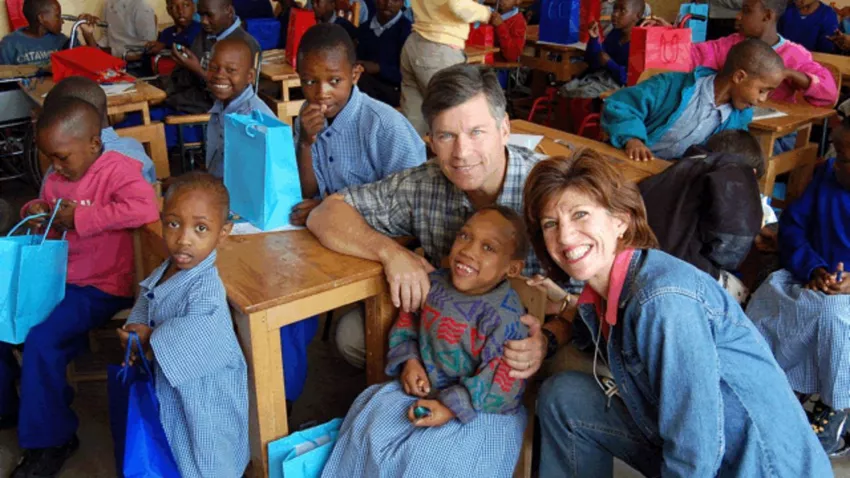
Today, Faraja Primary School serves children with disabilities by providing education, room and board, physical therapy and other services to about 100 students at a time. The school has about 35 staff members, according to Tolmie. Students learn about the school through their churches, according to Tolmie, and some come from communities hundreds of miles away to attend.
For disabled children in Tanzania, the challenges often extend beyond their physical condition.
In many Tanzanian communities, Tolmie said there is a social stigma around people with disabilities — a belief that a mother whose child is born with a disability is somehow responsible or has been cursed.
“Oftentimes, also the fathers say, ‘Well, this is your problem, not mine; I’m out of here,’” the Faraja Fund Foundation chairman said. “Too often it’s just the mothers and the grandmothers who are left to struggle with this challenge.”
In addition to the societal challenges, children with special needs in Tanzania often lack access to medical care and resources.
“So much of Tanzania is poor, and it’s rural, and just getting access to even knowing what’s wrong with their child, knowing that it’s medically not their fault, knowing that there are medical solutions that can at least lessen the challenges of the disability,” Tolmie stated.
Before being accepted, prospective students are interviewed and evaluated by a team from the school, including medical specialists. The school assesses whether students are capable of meeting the standard curriculum requirements set by Tanzania’s government.
“And so, many children’s disabilities affect them both physically and mentally,” the chairman said. “Those children, unfortunately, cannot come to our school.”
Students who are able to attend receive room and board, physical or occupational therapy, medical care and vocational training. Through a partnership with the Kilimanjaro Christian Medical Center, students can receive corrective surgeries and then return to campus to work on mobility and learn to walk and play.
The school also offers computer training and vocational instruction in skills such as tailoring, carpentry and jewelry or bead making.
“And the idea is not so much that they’re going to be a trained and certified carpenter when they leave primary school but that they develop an interest and an aptitude so that as they move on to the next step, they’re ready, willing and capable of going,” Tolmie said about the vocational training.
The school’s annual operating budget is approximately $300,000, which the foundation raises through donors.
“Almost all of our money has been raised through friends and family and people that we know to have them sponsor a child,” Tolmie said. “So we have over 200 donors now.”
Through the sponsorship program, donors can correspond with the children they sponsor, which, Tolmie said, allows them to see the impact they have on students’ lives.
While most Faraja students are Christian, the school accepts children from all religious backgrounds, including Muslim students. Christian students have opportunities to worship through Sunday services, choir participation and student-led Bible reading and prayer sessions.
“It’s not only a productive environment but a loving environment,” Tolmie said.
He also described the “next phase” of the foundation’s work, Faraja Forward, which aims to help children with disabilities outside of the Faraja Primary School.
The initiative reaches children with disabilities living in rural areas who have no access to doctors. Faraja Forward operates a mobile clinic and works with Tanzanian healthcare providers, nongovernmental organizations and other specialists to bring medical evaluations, physical and occupational therapy and training into remote communities.
“And, you know, when we say we provide help and hope for so many of these kids, we’re not going to cure them, but there is hope in seeing that somebody cares and supports them and hope in life to come,” Tolmie stated about the foundation’s work.
Photo Courtesy :


