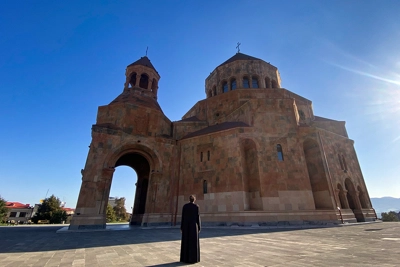
BY : Paul Murray, Op-ed Contributor Christian Post
Power may seize territory. It cannot seize truth.
Azerbaijan now controls Nagorno-Karabakh, known to Armenians as Artsakh. The ethnic Armenian government that existed there for decades is gone. More than 120,000 Armenians were forcibly removed from their ancestral homeland following months of blockade, severe deprivation, and Azerbaijan’s September 2023 military offensive. Azerbaijan now possesses the towns where they lived, the cemeteries where they buried their dead, and the monasteries where Armenian Christians worshiped for centuries.
That control carries a moral responsibility. It does not give Azerbaijan the right to rewrite the identity of the people it displaced or the sacred places they left behind.
Instead, Azerbaijan appears determined to win an argument with history itself. This month, its government brought approximately 150 representatives from 58 countries and nine international organizations on an official tour of Nagorno-Karabakh. At the medieval monasteries of Gandzasar and Dadivank, Hikmet Hajiyev, President Ilham Aliyev’s foreign policy adviser, presented the sites as monuments of ancient Caucasian Albanian Christianity. Azerbaijani officials accused Armenians of altering the buildings and compromising their original character.
Caucasian Albania was real. The fiction is the attempt to use its existence to erase the Armenian medieval identity of monuments whose walls record that history.
Gandzasar contains extensive Armenian inscriptions documenting its construction, patrons, and religious affiliation. An inscription by the thirteenth century prince Hasan Jalal identifies him as the builder and records the church’s consecration in 1240. Dadivank likewise contains Armenian inscriptions and khachkars, the distinctive carved cross stones of Armenian Christianity. By the medieval period, the Albanian Catholicosate invoked by Azerbaijani officials existed within the Armenian Apostolic Church. Gandzasar later served as its seat.
Scholars may debate the complicated history of the South Caucasus. Governments, however, have no right to remove inconvenient inscriptions from the historical record. There is certainly no justification for mocking that history, as Hajiyev is seen doing while members of the diplomatic delegation laugh.
There is nothing amusing about the attempted erasure of a people’s history, especially after those people have been driven from the land where that history was written.
This is more than an argument over architecture. It is a question of human dignity and moral responsibility. A government does not honor its strength by humiliating the displaced or asking sacred stones to deny the people who carved them. True strength preserves the truth, including the parts that complicate a nation’s preferred story.
Azerbaijan has particular reason to understand this responsibility because there is a disturbing precedent within its borders.
In the exclave of Nakhchivan, Caucasus Heritage Watch documented the destruction of 108 Armenian monasteries, churches, and cemeteries between 1997 and 2011. This represented 98% of the Armenian cultural sites the project documented there. Among the losses was the medieval cemetery at Julfa, which once contained thousands of Armenian khachkars. The cemetery was systematically destroyed, and Azerbaijan later denied that it had existed while preventing independent investigators from examining the site.
Now physical traces of Armenian life are disappearing in Nagorno-Karabakh. Satellite monitoring has documented the destruction of churches, cemeteries, and villages. Karintak has been almost entirely razed. In Stepanakert, Azerbaijan has demolished two Armenian churches, including the Holy Mother of God Cathedral, which was consecrated in 2019. A cemetery in Shushi containing Armenian and Russian graves, medieval khachkars, and nineteenth century gravestones was also destroyed.
These are not isolated incidents. They reveal a pattern that should concern every government and every person of conscience. Historical erasure is not simply an offense against the past. It is an ongoing injury against people who have already lost their homes, communities, and access to the graves of their ancestors.
Azerbaijan has every right to tell its national story. It does not have the right to insist that the Armenian story never happened. An Armenian inscription carved into a church seven centuries ago poses no threat to Azerbaijan’s sovereignty. It simply declares an undeniable truth. Armenian Christians were here.
The international community must demand that Azerbaijan grant UNESCO and independent heritage specialists sustained access to Nagorno-Karabakh. There must be a comprehensive inventory of Armenian churches, monasteries, inscriptions, manuscripts, khachkars, and cemeteries. Their Armenian identity must be documented and preserved. Forcibly displaced Armenians must also receive meaningful access to their sacred places and family graves.
The diplomats who participated in the tour also bear responsibility. They represented governments and international institutions. A tour controlled by Azerbaijan is no substitute for independent observation. Those who laughed should explain what they found amusing. Those who remained silent should now demand transparency. Diplomatic courtesy must never become complicity in cultural erasure.
Christians around the world must also refuse to look away. Gandzasar and Dadivank are sacred places where generations prayed, worshiped, buried their dead, and confessed their faith in Jesus Christ. When their Christian identity is erased, the wound is not borne by Armenians alone. It is borne by the wider Body of Christ.
Silence is not neutrality when churches are destroyed and Christian history is rewritten. If the global Church waits until the inscriptions are removed, the cemeteries are gone, and the monasteries have been stripped of their Armenian identity, our concern will have arrived too late.
Azerbaijan may control the territory, but it must not be permitted to control the truth. No government has the moral authority to erase a people and then claim their sacred history as its own.
Peace cannot be built upon forced displacement, destroyed churches, and rewritten history. Peace built upon a lie is merely injustice waiting for the world to forget.
The world must not forget. The Church must not remain silent. If governments and people of conscience look away, the stones themselves will continue to bear witness.
Armenian Christians were there. Their faith remains. Their history must remain.
Photo Courtesy :