


US military intervention in Nigeria didn’t stop escalating attacks on Christians, lawyer says

BY : Ryan Foley, Christian Post Reporter
A lawyer who advocates for Christian women and girls abducted and forced to convert to Islam says the United States military intervention initiated in Nigeria in the last year has not been “helpful” in stopping the escalating Christian persecution in the African country.
In an interview with The Christian Post, the lawyer, who uses the pseudonym Jabez Musa, shared stories of kidnapped Christians facing horrendous conditions in detention, along with his own experience with anti-Christian threats.
“In the long run, it has not been helpful because when the U.S. used its jets and bombed the attackers, Christians felt that if it were to be sustained, it would have been helpful. But it was not sustained,” Musa said.
“The attackers have re-strategized, and the attacks have increased instead in all the regions. And it is now going down to the southern part of Nigeria. So we would say that it has not helped actually.”
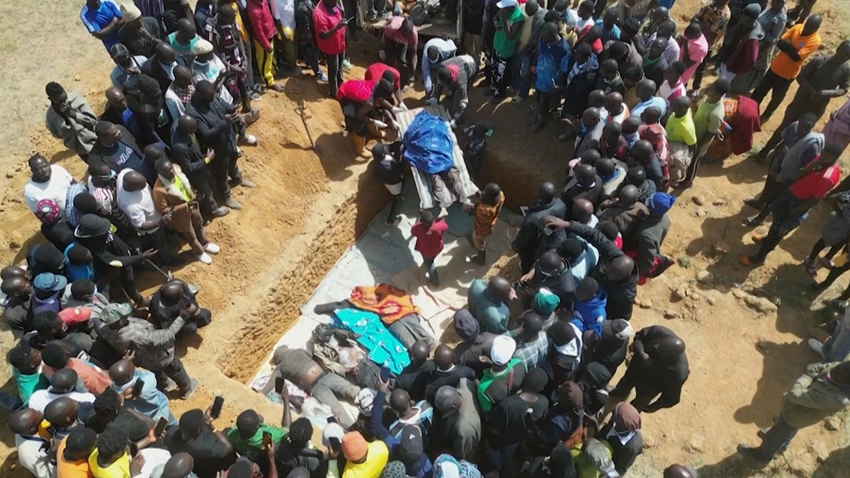
Thousands have been killed across Nigeria in recent years amid rising attacks on predominantly Christian farming communities across the country’s Middle Belt, with critics accusing the Nigerian government of not doing enough to protect its citizens. Violence has also gripped Nigeria’s northern states amid the rise of Islamic extremist groups like Boko Haram and the Islamic State. Millions of Nigerians have been displaced.
The issue has caught the attention of President Donald Trump and his administration. Last October, Trump alleged that Nigeria had failed to protect its Christian communities amid escalating violence that he says posed an “existential” threat to Christianity in the region.
The president had the U.S. State Department place Nigeria on its list of countries of particular concern for tolerating religious freedom violations, a diplomatic measure aimed at putting pressure on the Nigerian government, which has historically downplayed the violence and denied allegations of a Christian genocide.
The U.S. launched airstrikes against Islamic State terrorists in northern Nigeria last Christmas Day. In early 2026, the U.S. deployed troops to Nigeria as part of an effort to assist in counterterrorism operations against Islamic State-linked terrorists.
U.S. Secretary of War Pete Hegseth had previously said the effort had killed hundreds of Islamic State militants. But most U.S. troops were withdrawn from the country last month — a move Musa believes left the intervention incomplete.
Musa said that the Nigerian government has offered “a semblance of action by arresting some of the attackers, getting them charged in court and it stops there.”
“We see daily attacks being carried out by the militants,” he said. “And the communities have no protection. They are on their own. People are killed, and women are abducted.”
Musa told the story of a woman and three children, ages 12, 6 and 4, who were abducted by Fulani militants during an Easter Sunday attack on their church. Dozens of churchgoers, including men, women and children, were taken into a forest. Although the woman escaped the camp, she lost her daughter to complications from an underlying illness along the way.
Musa quoted directly from the survivor’s testimony, with the mother describing how “the 4-year-old baby was already critically ill while we were still in the camp.” She noted that “Her eyes and legs were badly swollen and she could no longer walk.”
“I carried my daughter Christie on my back. Whenever I became too weak to continue, I would give her to my 12-year-old son to help carry his younger sister despite his own exhaustion,” the woman explained. “All four of us walked barefoot through the forest for two days without food and water.”
Musa said the family escaped on Aug. 1 and “trekked until nightfall and slept in the bush.”
The 4-year-old girl died after the family resumed their journey home.
Another woman, Victoria, gave birth in captivity after she was kidnapped in the Easter Sunday attack, Musa said.
“According to her, ‘the terrorists forced one of the captives to use her teeth to cut my baby’s umbilical cord because there was no sharp object or medical assistance but my baby died three weeks later.’”
Christians were arrested for the killing, but Musa believes “he was killed somewhere [else], but his corpse was brought to Jos just to smear the Christian community.”
Musa said that after the general’s death, “militant Muslim youths threatened to attack my village.” He described the toll on his family: “We were not sleeping at all and we were not seeing [the] government coming to our rescue.”
Musa outlined his work on behalf of women and girls who have been abducted and forced to convert to Islam.
One pending case involves a girl abducted from Jos and taken to Bauchi State, a neighboring state to Plateau State.
“She was about to be married off to a Muslim through the Hisbah,” he said. “The Hisbah organization is an Islamic organization that was formed shortly after northern states introduced Sharia in the year 2000. Their parents contacted us, and we wrote the Hisbah organization through the government of Bauchi State, and we were able to trace the girl.”
Musa expressed optimism about the case.
“Right now, we are in court and hearing will soon commence. We are convinced that we are going to use the court to get the girl released,” he said. “Otherwise, she would be married off, and she would be converted to Islam and forgotten.”
“There are many Christian girls like this girl,” he acknowledged, who have been “abducted and have been converted without us knowing at times.” In some cases, the Christian girls “are now Muslims.” Musa and fellow Christian lawyers collaborate with journalists, “who give us the information at times to secure most of these girls.”
While Musa remained critical of the Nigerian government’s efforts to combat Christian persecution, he praised the courts for their “independence.”
“The court is largely independent, but there are instances that we see that some courts lack independence,” he said.
“In most cases of human rights abuse, the court largely is independent,” he continued. “Between April and June or July, there has been mass trials of these militants in Abuja through some federal high courts, and we’ve seen some of them … have been sent to prison.”
Musa called on the international community to “act fast because the rights of Christians are being denied.”
“Thousands are killed almost every day, and then their right to privacy is being distorted because their communities are being attacked and they are displaced.”
“And quite a number of Christians are in camps, and the camps too have problems, health challenges … that the [displaced] are facing, food shortages, [medication is] in short supply, food, education for children,” he maintained. “And you have sanitary problems and then other … problems that they face.”
Photo Courtesy :


