BY : Wendy Yurgo, Op-ed contributor Christian Post
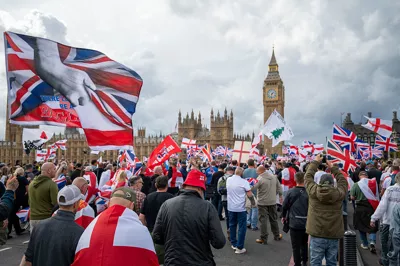
On May 16, as tens of thousands marched through London under one of the largest policing operations Britain has seen in years, one image towered above all the others.
Wooden crosses were carried openly through the streets of England.
While the media rushed to label the entire rally “far right extremism,” millions of people watching the footage saw something much deeper unfolding in real time. A nation struggling openly with questions of faith, identity, freedom, morality, and survival.
What happened in London was bigger than politics and bigger than Tommy Robinson himself.
Christians carrying crosses marched beside Jews, Iranian dissidents flying the Lion and Sun flag, women’s rights activists, veterans, families, and ordinary patriots united by one overwhelming belief: the West is losing confidence in the values that once made it strong and free.
They did not agree on every issue.
But they shared two things that mattered deeply: Love of country and the belief that faith, morality, courage, and civilizational identity still matter.
The establishment had already written the story before the first marcher stepped into the streets. Tommy Robinson supporters would be branded extremists. The rally would be called hateful and dangerous. Keir Starmer’s government rolled out thousands of police officers, helicopters, facial recognition technology, and massive security operations while legacy media outlets warned the public to brace for violence and racism.
Foreign speakers were banned from entering the country. Dissident voices were blocked at the border. Even members of Poland’s parliament and other European nationalist figures reportedly faced restrictions tied to attending the rally. Britain claims to defend democracy and free expression while barring people for political views that the establishment dislikes.
And still the people came.
The scenes from London complicated the narrative immediately.
Families marched. Veterans marched. Women waved flags proudly. Christians carried crosses. “Jesus is King” chants echoed through parts of the crowd. Iranian dissidents stood beside British patriots, warning the West not to ignore the dangers of Islamist extremism and ideological intimidation because many of them had already watched those forces devastate their own homeland.
That part matters.
The presence of Iranian exiles in London was not accidental symbolism. Many did not stand beside British patriots because they hated freedom or diversity. They stood there because they know firsthand what it feels like to lose a nation piece by piece. They watched Iran collapse from an ancient civilization with deep cultural pride into a regime shaped by fear, repression, extremism, and the crushing of dissent.
To many of them, what is happening in Britain is not theoretical. They believe they have seen this movie before. At the center of the rally stood Tommy Robinson, one of the most controversial and relentlessly attacked men in modern Britain.
Critics see the arrests, the headlines, the confrontations, and the rough edges. Tommy himself has never hidden his past or pretended to be polished. He came from the streets, speaks like it, and carries the scars of years spent battling hostile media, hostile institutions, and a political establishment determined to erase him from public life.
But to many ordinary Britons, Tommy Robinson represents something far deeper than politics.
He represents courage.
The courage to speak when silence would be safer. The courage to endure public humiliation without backing down. The courage to openly love England at a time when patriotism itself is often treated as suspicious or dangerous.
He openly loves his country in an era when many leaders seem embarrassed by theirs. The emotional connection people feel toward him is impossible to deny, whether people agree with all his tactics or not. Tens of thousands did not flood London simply for a political rally. Many came because they believe someone is finally voicing fears, frustrations, and spiritual anxieties that much of Britain’s leadership refuses to acknowledge.
The wooden crosses mattered too.
Not because everyone in the crowd was Christian, but because the crosses symbolized something bigger than politics. Christianity shaped the moral foundations of Western civilization. Liberty. Conscience. Human dignity. Equality before God. Forgiveness. Sacrifice. The inherent value of every human soul.
A civilization that disconnects itself completely from those roots eventually loses more than tradition.
It loses moral clarity.
Whatever one thinks of Tommy Robinson personally, dismissing every concern expressed that day as mere “hate” ignores something much deeper happening inside Britain and across much of the West. Millions of ordinary people no longer believe their political, cultural, and even spiritual institutions are willing to defend the moral and civilizational foundations that once sustained freedom itself.
That vacuum has consequences.
Christians should be careful not to confuse nationalism with the Gospel. The Kingdom of God is not built through political movements or earthly power. But Christians also cannot ignore what happens when societies abandon truth, moral confidence, national cohesion, and the spiritual foundations that once shaped their understanding of freedom and human dignity.
This is not the Britain Winston Churchill once described as a Christian civilization willing to defend liberty against tyranny at all costs.
Today, many believers feel Britain is spiritually adrift. King Charles III may formally sit as head of the Church of England, yet many ordinary Christians see institutions that appear uncertain, compromised, and uncomfortable defending the Christian identity that once shaped the nation itself.
That silence has left many citizens searching elsewhere for moral clarity and courage.
The media can continue reducing every expression of patriotism, cultural concern, or spiritual anxiety to extremism. Politicians can continue dismissing ordinary people as hateful or ignorant for voicing concerns about crime, extremism, social fragmentation, or the erosion of national identity.
But the images from London revealed something impossible to ignore.
Many people across the West are no longer convinced secular modernity alone can hold their societies together.
The crosses carried through London on May 16 spoke louder than the headlines.
They reflected a growing belief that the crisis facing Britain is not merely political.
It is spiritual.
Photo Courtesy :